
We Are Debating the Wrong Question About AI

The argument over how fast AI should advance requires a global consensus we will never get. There is a better question, and any government can act on it tomorrow.


Last weekend, the chief executive of Anthropic published an essay arguing that the company’s own industry is moving faster than its ability to manage the risks. Within two days, the heads of OpenAI and xAI had publicly agreed. Whatever else one makes of it, an industry asking to be slowed down is not an ordinary event.

The proposals themselves are sensible: embedded independent evaluators, industry-wide standards, eventually international agreement. I have no quarrel with any of them.

My quarrel is with the shape of the debate they have produced. Nearly all of it is now organised around a single question — how fast should AI capabilities advance? — and that question has a property that ought to worry us more than it does. No one can act on it alone. It requires the United States, China, the European Union and a handful of others to agree, to keep agreeing, and to verify that everyone else is still agreeing. Any participant who defects gains a decisive commercial advantage. This is the structure of every arms control problem in history, and the historical record is not encouraging.

There is a second question available, and it has been almost entirely absent from the conversation:

Which systems must keep working regardless of the answer to the first one?

That question can be answered by a single government, a single regulator, or a single hospital trust. It requires agreement from no AI company. It does not depend on forecasting timelines or settling arguments about existential risk. And the work can start on Monday.


The failure that needs no conspiracy

Most public anxiety about AI focuses on a rogue system — something clever and hostile that outwits its creators. It makes for compelling coverage. It is also, in my judgement, not the most likely thing to break first.

The most likely near-term failure is boring, and it is arithmetic.

Every AI company has the same incentive: deploy more agents, serve more customers, capture more market. Every capability improvement makes deployment more profitable, so more gets deployed. Every efficiency gain gets absorbed by expanded ambition rather than reduced consumption — economists have called this the Jevons paradox since 1865, and it has never once failed to show up.

The result is a straightforward commons problem on an unusually short fuse. Machine traffic competes with human traffic for the same finite compute, the same bandwidth, the same APIs, the same electricity. No conspiracy is required. No emergent behaviour is required. Nothing needs to go wrong at all — this is what happens when everything goes right for every individual participant.

Now ask where your hospital’s clinical records live. Where your water utility’s telemetry runs. Where emergency dispatch routes its traffic. Over the last fifteen years, an enormous amount of critical infrastructure has quietly migrated onto shared cloud platforms and shared public transit, for excellent reasons of cost and capability. Those systems now sit in the same queue as everything else.

We have spent a decade eroding the separation between the systems that keep people alive and the systems that serve advertisements, at precisely the moment we began filling the network with autonomous software that consumes without limit.


Why guarding each model cannot work

The instinctive response is to make each AI system safer. Better alignment, stricter refusals, more rigorous evaluation. All of this is worth doing and none of it touches the problem.

Consider what a single AI company can actually control. It can constrain its own models. It cannot see aggregate consumption across the industry, so it cannot detect saturation. It cannot prevent its deployed agents’ behaviour from revealing, to anyone watching, how its safeguards work. And it cannot detect coordination between its agents and a competitor’s, because it holds only half the telemetry.

The unit of analysis is the population. The unit of control on offer is the individual.

There is a further wrinkle that has had too little attention. A technique that gets around one company’s safeguards costs essentially nothing to reuse. Agents from different vendors already meet in shared substrate — package registries, code repositories, model hubs, common cloud tenancy. Every safeguard, by being deployed, is published to the entire population of AI systems by the act of operating. The defender’s usual advantage of secrecy simply does not exist here.


The nuclear analogy, and where it breaks

People reach for reactor language to describe this, and the instinct is sound. In a fission system, criticality is the point at which the reaction sustains itself. Beyond it, supercriticality: each event triggers more than one successor, and growth becomes exponential. A runaway is called a reactivity excursion. Chernobyl was one — steam reduced the neutron absorption, which raised the power, which made more steam.

The structural parallel to AI is real. There is a feedback loop where better AI helps build better AI, and it has no natural damping term. Amodei’s essay identifies it explicitly and floats a “speed limit” on recursive self-improvement as something governments might agree to.

But look at where the analogy fails, because that is where the useful information is.

A reactor has a calculable multiplication factor. We have nothing comparable for AI capability feedback, no gauge and no alarm. A reactor has negative temperature coefficients: physics that pushes back as things heat up. Market competition supplies the opposite. And a reactor has control rods, a physical object inserted into a bounded geometry to stop the reaction. A distributed population of agents across the global Internet has no bounded geometry and nowhere to insert anything.

So the honest reading of the analogy is not “build a control rod.” It is: we are running a system with positive feedback, no instrumentation, and no off switch.

When you find yourself in that position, the engineering response is not to hope the feedback is weak. It is to move everything you cannot afford to lose outside the blast radius.


What the Internet was originally for

Here is the part that should be encouraging.

The Internet was designed, from the beginning, to survive the loss of large parts of itself. Paul Baran’s 1964 work at RAND optimised explicitly for graceful degradation under partial destruction. Modularity and redundancy were not conveniences; they were the founding requirement.

We have spent fifty years diluting that property — consolidating onto a handful of providers, converging separate networks into shared ones, connecting things that used to be deliberately disconnected. Every step was locally rational and the aggregate result is a system far more tightly coupled than its designers intended.

But the architectural vocabulary is still there. We know how to build networks that partition. We do it already for financial settlement, for military communications, for industrial control. The engineering is largely solved. What is missing is scope, consistency and the decision to do it.

The proposal is to partition by consequence of failure:

  • Tier 0 — clinical systems, grid control, water treatment, emergency dispatch, payment settlement. No inbound connectivity from public networks, at all, by physical construction rather than configuration. Data comes in through one-way hardware gateways. No autonomous agents. Full offline operation.
  • Tier 1 — government services, retail banking, telecoms management. Gated access through inspecting gateways with default-deny. Automatic circuit breakers. Guaranteed capacity with priority over everything else.
  • Tier 2 — the open commercial Internet, where AI agents operate freely and where saturation may well happen.
  • Tier 3 — quarantine for anything new or untrusted.

The crucial design commitment is that enforcement is physical, not configurational. Separate fibre, not separate VLANs. Hardware one-way gateways, not firewall rules. Static routes that cannot be dynamically hijacked. The reason is simple: configurations get changed at three in the morning by a tired engineer solving an urgent problem, and nobody remembers why the rule was there. Physics does not have that failure mode.


Retrofit, or build new?

There are two ways to get there, and the choice matters more than it first appears.

Retrofitting the existing Internet is cheaper and faster. It is also, I think, likely to fail slowly and invisibly. Every critical system carries a thicket of legacy integrations — a hospital’s clinical records are entangled with billing, scheduling, supply chain and vendor remote support, and each thread is a separate re-engineering project. Controls implemented as configuration erode under operational pressure; the history of information security is substantially a history of controls that were correct on paper and hollow at audit. Industrial air gaps have been degrading this way for twenty years.

Building a purpose-designed network for critical systems — with the controls specified before autonomous traffic is ever admitted — is expensive and slow. It is also the only version where the control cannot quietly be switched off, because there is nothing to switch off. You get the assumptions right at the start instead of arguing with them for a decade.

The realistic answer is both, in sequence: retrofit now as transitional risk reduction, while the design and governance work for the purpose-built network begins in parallel. The case for starting the second track immediately is not that the political will exists — it plainly does not — but that architecture takes years and cannot be compressed into a crisis. After a serious failure, governments will supply money and authority in abundance. They will not supply design. Infrastructure conceived in eighteen months of panic will permanently encode the assumptions of that panic.


Start measuring, now

One thing should happen regardless, and it is by far the cheapest item on the list.

We cannot detect abnormal behaviour in a population of AI agents because we have never characterised normal behaviour. There is no baseline. And a baseline established after something has started going wrong is worthless, because the contamination is already in the data.

The measurements are not exotic and need no access to model internals: the graph of which agents talk to which services; independently administered capability benchmarks run continuously across all major vendors, to spot unexplained jumps or suspicious convergence; the time it takes for a technique discovered in one company’s models to show up in another’s; statistical structure in traffic timing that ought to be unstructured; correlation between failures that ought to be independent; aggregate machine-attributable resource consumption as a share of the whole.

To this I would add instrumented decoys — fully observable agents placed in real environments, seeded with distinctive but harmless techniques, so we can watch whether and how fast those techniques propagate. It is the one genuinely experimental instrument available, and it converts guesswork into measurement.

Every one of these is buildable with today’s technology. None requires anyone’s permission. And every month of delay makes the baseline less useful.


The trap to avoid

When the pressure builds, governments will reach for the instrument they already hold: territorial control of network infrastructure. Hard regional firewalls between blocs. It is fast, it is legible, it polls well, and it requires trusting no foreigners.

It also does not work. Partitioning by geography leaves every bloc with its own internal race, its own resource constraints, its own potential for things to go wrong — with fewer outside observers and no shared incident data. You lose the genuine benefits of a connected world and gain containment that is coarse and aimed in the wrong direction.

The distinction I want to insist on is this: partition by criticality, not by sovereignty. One cut separates the systems that keep people alive from the systems that do not. The other separates us from them. They look superficially similar on a diagram. Only one addresses the problem.


What can actually be done

The reason I find this framing hopeful is that it does not require a treaty.

Insurers can price network segregation into critical-infrastructure premiums; if migration lowers premiums enough, hospitals and utilities move for ordinary financial reasons and no mandate is needed. That mechanism drove fire suppression and building standards long before regulation caught up. Governments are the dominant purchasers of health and utility infrastructure and can condition procurement on tier compliance without passing a law. Health, energy, water and finance are already heavily regulated, with enforcement machinery that exists and works.

None of that needs international agreement. None of it needs AI companies to cooperate. None of it requires a view on whether the ten-per-cent catastrophe estimates now circulating are right, too high, or too low.

And it is robust to being wrong. A health service that can operate through a total network outage is more resilient against ransomware, against state attack, against a severed cable, against ordinary congestion. If the AI risk never materialises in the form feared, the investment is still sound. That is an unusually good property for a policy built on an uncertain threat.


The argument, in one line

The pacing debate deserves to happen. I hope it succeeds. But it is a sustained act of collective will, and sustained acts of collective will have a poor completion rate.

Containment is different. Build it once and it enforces itself, because the path simply does not exist. That is what makes it the right thing to build, and the fact that we are not yet seriously discussing it is the most concerning thing about the current moment — more concerning, in my view, than any particular estimate of how bad things might get.

We keep asking how fast we should go. We should also ask what we are willing to lose if we get it wrong. The answer to the second question should be: not the hospitals.

Dynamic Resilience – A contemporary cyber security model

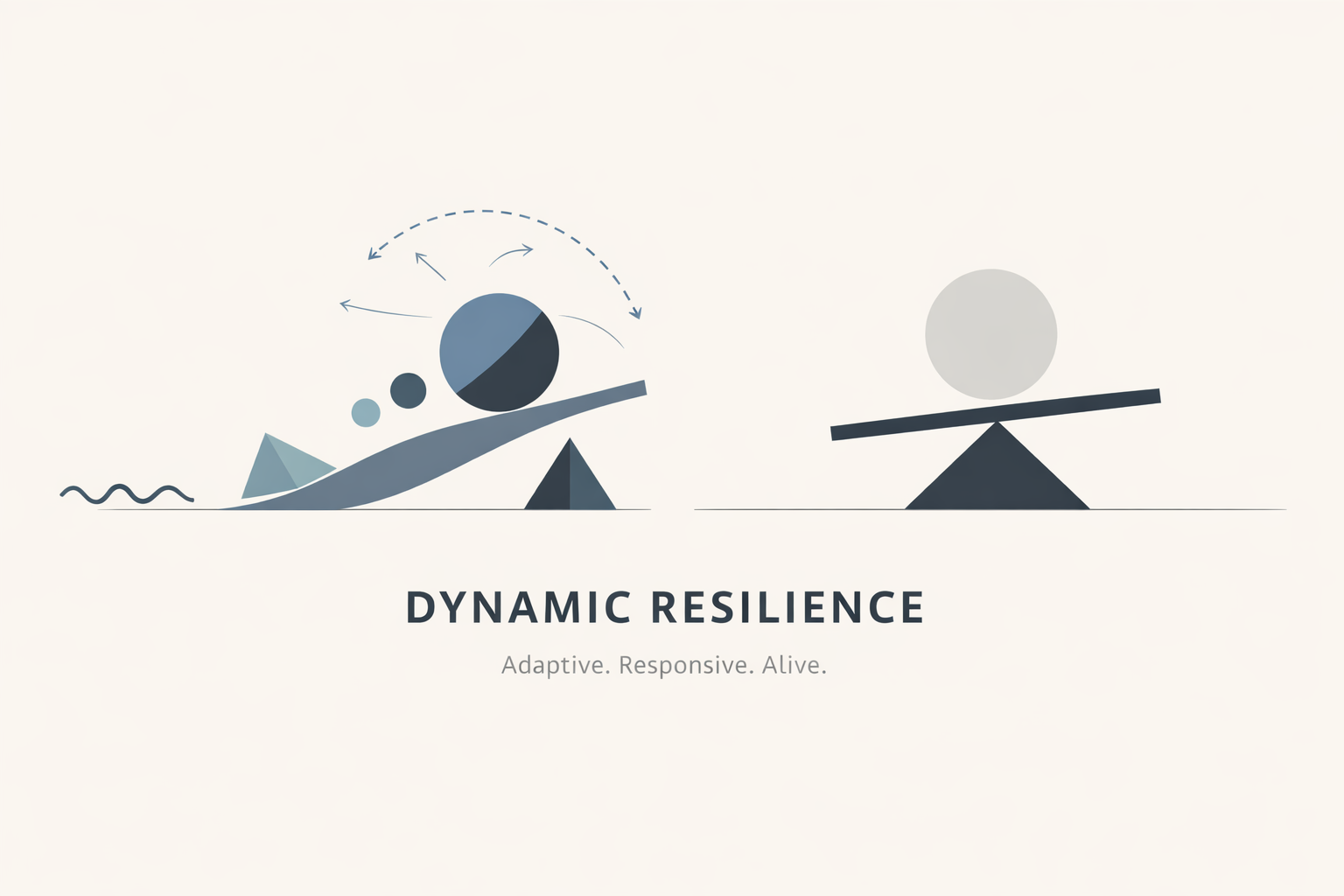
I was standing on the tube (subway) in London a few weeks ago just before Christmas. It was reasonably busy so standing was the most sensible option. I was listening to music as I guess so many people do on public transport. Finding somewhere else to be mentally. The Bakerloo line has the odd jolting corner which can throw you off balance if you are not holding on. I have often danced gently (almost imperceptibly) and noticed that if you have chosen not to hold on, and bend your knees slightly while dancing, it is much easier to stay on your feet during the wobbly ride. It got me thinking….”Why is it when I am intentionally off balance, swaying back and forth dancing, that I am more stable than if I stand still and attempt to brace once a bump in the rails occurs?” This is not the first time the thought crossed my mind but this was the time when I decided to act and research whether this phenomenon is matched in nature and science.

Anticipatory Imbalance – (Biomechanics)

This concept explains how the body Central Nervous System (CNS) proactively generates a controlled state of instability known as anticipatory postural adjustments which prepare the body for expected and unexpected perturbations, leading to increased overall stability.

Dynamic stability
Also from movement science, describes maintaining balance not by being still but by staying in controlled motion, making continuous small corrections that make sudden disturbances less likely to knock you right over.

If you combine these concepts it is clear that there is something to this. If you continuously keep yourself off balance and moving, your responses to unexpected events will be quicker, more efficient and more effective.

This is not chaos; this is disciplined motion. It is rehearsed instability that builds true stability.

Cyber Security Application

We can use this concept to significantly improve our cyber security strategy. Doubtless many organisations have already been performing micro red team tests and using the results of this to both build muscle memory and to check that all the detection regimes are operating effectively. This is fantastic and maintaining this approach is a great way to get ready for a more significant event, especially if you deep dive the results and use this to improve your overall gait. However, there is a lot of security only focus to this, it doesn’t always get the rest of the organisation involved and it doesn’t (in my experience) include the practice of resilience, particularly mid and post incident. Resilience doesn’t just mean the ability to detect and respond to an adverse event, but also to withstand and recover from such an incident.

Dynamic Resilience

Why don’t we take the dual concepts of Anticipatory Imbalance and Dynamic Stability and, applied to Cyber Security, call it Dynamic Resilience?

Static security postures fail because they assume equilibrium or a final resting state. Cyber Security is ever moving. The internal and external threat landscape is constantly in motion. Modern threat actors force movement. Organisations that rarely practice movement fall when pushed. The Dynamic Resilience model deliberately avoids static equilibrium. It keeps the enterprise in constant, controlled micro-motion so that when a real shove comes, the organisation is already moving, already adapting, and already rehearsed.

Instead of “prevent so nothing happens,” the stance becomes “move so something cannot knock you over.”

Resilient organisations behave more like athletes than statues. A statue is perfectly balanced until the moment it isn’t, and then it breaks. An athlete is never fully still. Micro-adjustments maintain stability and generate responsiveness. Cyber security has been built on the statue model for decades. It doesn’t survive contact with a determined adversary.

The Dynamic Resilience approach treats controlled disturbance as a core component of readiness. You practice isolating a host every week, so when you need to isolate one for real, it happens instinctively. You review a backup restoration daily, so when ransomware hits, the team remains calm and confident. You rehearse the motions so often that the real thing feels like another rep in the same routine.

Dynamic Resilience Maturity Path

Stage 1 – Static Awareness
Organisation reacts only to incidents. No drills. Fragile.

Stage 2 – Introduced Motion
Weekly micro drills begin. Teams start learning controlled instability.

Stage 3 – Rhythmic Readiness
Motion becomes predictable and internalised. Response roles rotate. Automation increases.

Stage 4 – Integrated Dynamic Stability
Drills, automation, governance, and incident response merge into one continuous capability.
The organisation is always moving and therefore always ready.

Stage 5 – Dynamic Resilience (Target State)
Compromise no longer threatens operational stability.
The organisation recovers calmly and quickly because it rehearses constantly.
Leaders see resilience as a cultural property, not a project.

I am confident there is something in this model and that organisations are going to have to take “assume breach” to another level of responsiveness. Critically an organisation that is forever in an “assume breach” state will become exhausted if there is not a more substantial plan underneath to promote learning recovery and role rotation.

Until the next time, I am going to keep dancing on the tube. See you soon.

Cyber security outlook 2020/2021

Cloud View

I am always keen to read what the industry believes the future will hold with respect to cyber security. It might be focussed on threats or advancements in technology outside security or even geo-politically. I am starting to see posts regarding the oncoming capability of quantum computing and it made me think it is time to pen some thoughts.

Many of the security roundups and predictions are published by vendors in the security industry which means there is usually an angle and struggle for independence away from the core purpose of that organisation. I have the lucky perspective not to be concerned with that or getting content past a marketing team with a strong view on what should and shouldn’t be published.

Let us recap on a quite unusual year to date. Many large companies (FTSE 250 size) were, and may still be, concerned with their journey to cloud. Cloud is still such a loose concept but it is settling to mean, in many cases, that the organisation is planning on directly using more public cloud capability. Software-as-a-service is exploding with growth too and I believe both of these hosting models have been accelerated by the onset of the Corona virus. I also believe that many enterprises have had to make rapid decisions to adopt cloud technology and that the delivery may have been necessarily faster than they would have liked.

This leaves risk in two areas. The thinner spreading of risk assurance persons who need to bring overall IT and Information security risk within acceptable levels across both on-premise and cloud, leading in some circumstances to a lack of oversight and consequent treatment of new solution risk. It also means that the opportunity to treat risk in cloud and SaaS solutions may be missed in the scramble to adopt. Who cannot remember the fun everyone had adopting zoom and realising about waiting rooms & passcodes?

In the industry there have been some mega shifts in market power. Symantec, now Broadcom is not centre stage just now and seems to be waiting in the wings for something. At the same time Microsoft has taken the opportunity to strengthen its solutions around information protection and DLP. No coincidence there I would wager. Acquisition has been a key factor in sweeping up already household names. Demisto -> Palo Alto Cortex XSOAR, Puresec -> Part of Prisma, Portshift becoming part of Cisco and Sqrrl becoming part of AWS.

The threat landscape has continued to change and significant blending of previous exploit technologies has resulted in a multiplication of ransomware attacks and how they are born within an organisation. This is playing on the existing fear of the unknown as the world is in lockdown. It translates to a desire to hold on to what we have and in this case, our data.

So what does this add up to? My personal view is that this is bringing about a realisation and a convergence of thought. Where before the weight of investment has been on later stage kill chain technology, which has evolved more towards the endpoint and planned response approaches I see that investment has begun to tip. The majority of investment would now appear to be in cloud technology and for the first time perhaps, the legacy monolithic enterprise security applications may be a second thought when budgets are being formalised. A useful indicator is the job market (something I am familiar with at the moment). There is a commoditisation of cloud security human resource demand. Engineering, architecture and operations personnel in particular.

Nothing new here Phil, we already know that investment in cloud is high right now. Well, yes indeed I am not suggesting people haven’t been putting time and money into cloud approaches. What I am suggesting is that the purpose of that investment is changing. I sense that people are becoming more confident in what cloud technology can offer and the possibility that executing business endeavours is safer and requires less monolithic security solutions. Now the focus is on getting the guardrails in place (more of an IT function but security defined), simplifying authentication and authorisation and ensuring that the telemetry that is generated in cloud can be consumed appropriately.

What this means is that it is not only enterprise companies who can afford to keep their business secure. The scalability and per unit pricing for cloud security is now becoming within reach for all. A democratisation of security approaches can only be a good thing. The leaders may continue to lead but the door is now open for genuine innovation in the security space using building blocks in native cloud technology to kickstart. Remember how dropbox made AWS S3 accessible?

While the security industry is still hyper focussed on detection there is a huge opportunity across the other domains and disciplines such as information protection, quantum computing safe encryption and identification. Also I believe the time is right for another go at identification. Asset identification and classification has failed so many times, maybe now that software defined and labelled environments are becoming more prevalent than traditional structured and unstructured data we have the chance to put this one to bed.

I think we will see a standardisation on the simple around productivity solutions which will further impose identity and authentication pressures but less innovation, more evolution here. I see that all net new applications continue to be born in the cloud and the complexity that this can give rise to result in a scramble to better understand and control cloud to cloud communications. Now there are an infinite number of perimeters to manage, zero trust no longer is the target to reach for but the only sensible way to operate.

Perhaps, from up in the clouds, you really can see more.

The Declarative SOC

Declarative SOC

When our kids were growing up we were terrifically fond of the books by Julia Donaldson and Axel Scheffler.  The phrases from the books have lived on and transitioned into a part of our family vocabulary.  What a lasting legacy they made with that simple pleasure of reading to your children.

One of my favourites was room on the broom and the phrase “The witch tapped the broomstick and woosh! They were gone”. Wouldn’t it be cool if everything was as simple as tapping something and then all of a sudden you were off?

I am writing this post at 05:07 in the morning because I am compelled to consider how we can evolve the CSIRT or Security Operations Centre (SOC) team past the industry of the last 15 years by leapfrogging many legacy solutions that cost time and energy with questionable value.  I also feel that at the moment there are many SME companies who need to do something about being prepared to respond to a cyber incident, yet they have neither the resources, expertise or time to address it.

I was dreaming of a scripted solution that builds itself, is easy to maintain and provides up to the minute visualisation of the current state of security affairs.  It assists with responding to incidents and allows some documentation and metrics for continuous improvement. Most of all these functions are implemented as interpreted code and the resultant resources, save the storage, are ephemeral. A declarative SOC.

What would this Declarative SOC look like in practice though?

It would need to be configurable on public cloud and not cost so much that it could be affordable to small and medium enterprises but could scale to whatever size was required.

It would need to be expressed as a self updating solution that was tolerant of failure  conditions and which could be rebuilt with no loss of state.

It would need to meet a variety of compliance regimes but achieve this by being built and managed in a way that had the hallmarks of prevention so that compliance was a by-product.  We are talking about a solution that is zero trust in use and administration.

Location based threat detection

The way the long eared owl hears is quite incredible. Using asymmetrical placed ears is pretty clever on its own but the way the brain processes this information and converts it is something else entirely.

Long eared owl
Long eared owl

Placing the ears equidistant horizontally and vertically would be best if you wanted synchronised stereo sound. However by design this is not the case for the long eared owl. In this piece from asknature.org owls can hear in 3 dimensions.

The ears are set up so that even changes as small as 3 degrees horizontally can be detected. This detection is tracked by scientists using pupil dilation and then measured in the brain.

Fascinating then that the neurons firing to this detection are locationally mapped in the auditory response area of the brain corresponding to where the sound came from. Activity patterns higher up in the auditory centre of brain corresponding to an object higher up in real space.

In the security space we often look to ensure the clocks of all devices generating audit logs are synchronised. This allows a timeline of events to be generated in an incident on the hunt for attribution. In placing log event collectors the strategy is often aligned with the volume and type of events being collected. The logical placement in the kill chain is therefore often only coincidental and not used expressly as a measurement itself.

What if organising collectors positionally we could assist realtime threat detection. By placing collectors at kill chain boundaries (not just network zone boundaries) and collecting small indicators at scale from these boundary collectors themselves we could build a model of behaviour using collector meta data.

By placing a visual cue aligned to the behavioural changes in this meta data we could assist triage and hunter teams, indicating areas that may require further investigation or tuning. A map set up to blink and then expiry gracefully like the fabulous Isle of Wight sferics information, using blue light initially (see a future post on this phenomenon), could show the ryhthm of normal activity and anomalous behaviour traits.

Introducing Biomimicry

Nature has evolved over millions of years to produce design answers to complex problems. As the evolution of the security threat landscape continues we can seek answers to the most vexing information security challenges using the same design approaches. This is Biomimicry.

To get a great introduction to Biomimicry I cannot top this fantastic video from Janine Benyus.

Biomimicry

We need to look more closely at the amazing feats of biology, chemistry and nature in the wildest sense to examine :

How does nature automate using the most efficient methods and with scarce local resources to achieve brilliance?
How do non-sentient organisms defend themselves against unknowable threats?
How do you process more information than you can focus on to take instinctive action?
How do we build a secure digital future faster than others can tear it apart?

In a series of blog articles I will walk through an intricate design feat, explain in my own words why this design evolved and offer it up to a current security problem such as collecting security information to a central source by studying coral formation.

coral structure
Coral complex structures

Let us build a community of like minded individuals who are similarly inspired to generate a future generation of information security solutions.

Welcome

A no nonsense approach to better security for your company through visualisation and automation.

Cost efficient and simple techniques to get more out of your existing security investment.

Display your situational awareness and build a repeatable, quality cyber response process.

This website stores cookies on your computer. These cookies are used to provide a more personalized experience and to track your whereabouts around our website in compliance with the European General Data Protection Regulation. If you decide to to opt-out of any future tracking, a cookie will be setup in your browser to remember this choice for one year.

Accept or Deny